Last Updated: September 17, 2026
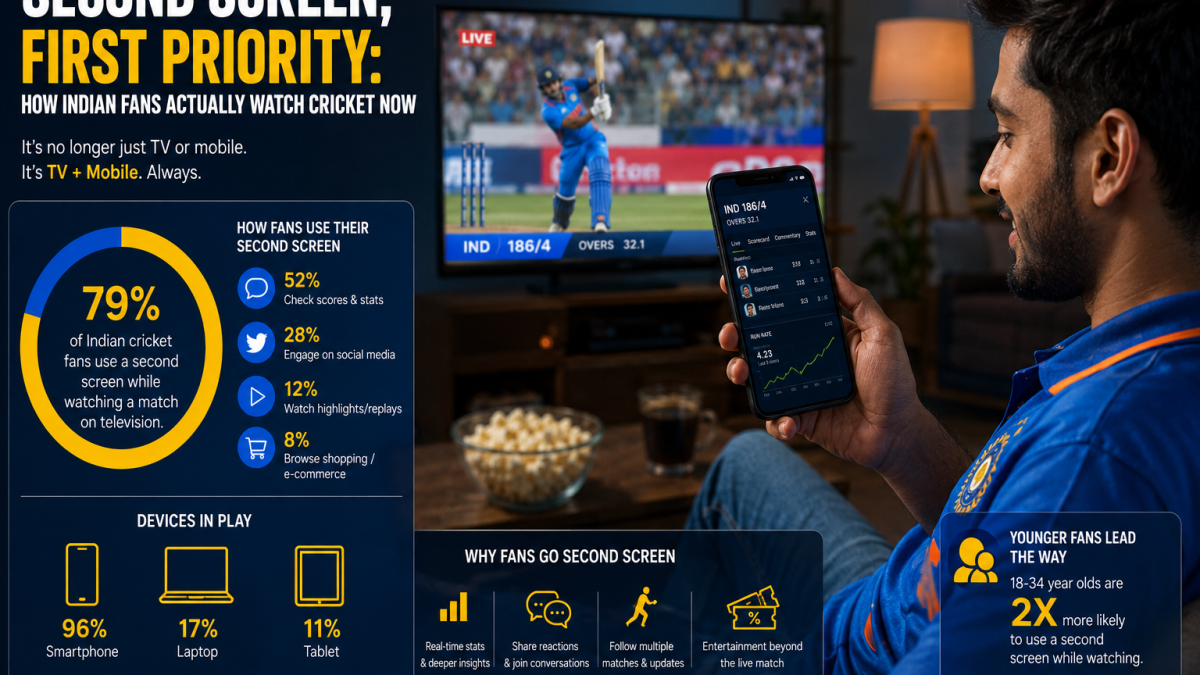
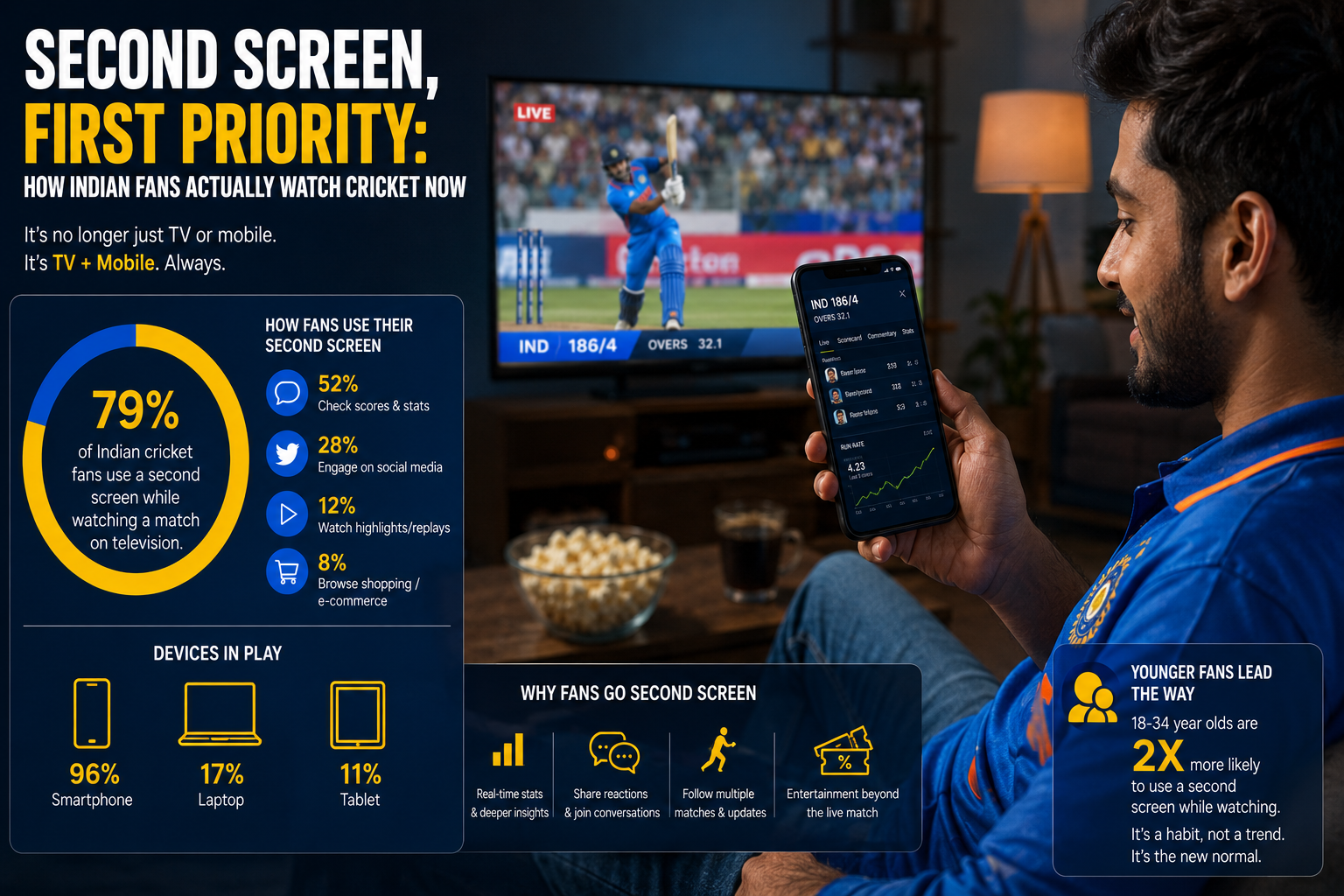
Picture a Saturday night IPL chase in an ordinary Indian living room. The television is showing the match. One phone has a family group chat already arguing about the last over. Another has ball-by-ball commentary open, because somebody wants to know the required rate to two decimal places. On the sofa, a teenager is watching a creator’s live reaction stream with the sound turned low.
Ten years ago, the match was the whole experience. Today it is the anchor, and much of the actual viewing happens across several screens at the same time. That shift has changed how fans talk about cricket, how quickly news travels, how broadcasters sell advertising, and even what counts as watching a match at all.
Table of Contents
From One Screen to Four
For a large share of Indian fans, streaming is now the main way to watch live cricket, and the phone is often the main screen rather than a companion to the television. After Reliance’s Viacom18 and Disney’s Star India business merged, IPL streaming moved to the combined JioHotstar platform in 2025, bringing the league’s television and digital viewing under a single roof.
Around that main feed, a typical match-night setup now includes some mix of the following:
- A score or commentary app for ball-by-ball text, statistics and match graphics.
- A group chat, usually on WhatsApp, where friends or family react in real time.
- A social feed on X or Instagram, where clips, memes and hot takes appear within minutes.
- A creator stream on YouTube offering audio commentary and reactions.
- Fantasy teams or live markets for fans who like to follow the game through numbers.
Nobody uses all of these at once for a whole match. But most regular fans move between at least two or three of them during an evening.
The Latency Problem Nobody Warned You About
The most common frustration of multi-screen viewing is simple: every screen runs at a different speed.
Live streams usually run behind the action on the field. Depending on your connection and device, the delay can be anything from a few seconds to half a minute. Score apps and push notifications often arrive faster. Group chats can be faster still, because somebody in the group is always watching on a quicker feed.
The result is the modern cricket spoiler. The family group lights up with “OUT!!” while the bowler on your stream is still walking back to his mark. A wicket alert pops up over the video before the ball is even bowled.
A few habits fix most of it:
- Silence wicket alerts for matches you’re watching live. Keep them for the matches you can’t watch.
- Mute the group chat during overs and open it at the breaks, such as the end of an over or a strategic timeout.
- Use the “go live” button on streams that drift further behind during the match.
- Watch on the fastest feed you have. A television or wired connection is often ahead of a mobile stream on patchy data.
Commentary Has Split Into Many Voices
The second screen also changed who talks you through a match.
Official coverage now comes in several Indian languages, and broadcasters have experimented with regional dialect feeds that turned commentary itself into a talking point. Alongside the official broadcast, creators run watch-along streams. They can’t show match footage, but they add a running conversation that feels closer to watching with friends than listening to a commentary box.
Many fans now mix and match: the picture from one source, the conversation from another, and the numbers from a third. Commentary has stopped being something you receive and become something you choose.
The Group Chat Is the New Stand
For many fans, the group chat does what the stadium stand used to do. It is where the collective groan happens after a dropped catch, where predictions get made and mocked, and where a single brilliant over becomes a meme before the next one starts.
That social layer changes how a match is remembered. The moments people talk about the next day are often the ones that produced the best reactions in the chat, not necessarily the ones that decided the result. A no-look six can outlive a match-winning spell simply because it made a better clip.
For brands, this is why “moment marketing” has become such a big part of cricket season. Creative that responds to a match event within minutes can travel through the same chats and feeds the fans are already using.
Stats on Tap
The second screen has also made Indian cricket fans unusually data-literate. Ball-by-ball text, wagon wheels, pitch maps, win-probability graphics and batter-against-bowler records are all a tap away.
It shows up in the way people talk. Casual fans now discuss strike rates against left-arm spin, death-over economy and powerplay intent in ways that used to be confined to analysts. Broadcast graphics have followed the audience, adding more live numbers to the main screen because viewers were already looking them up.
Fantasy play fed that habit for years by rewarding people who studied matchups. Since India’s 2025 law banned online money games, much of that activity has shifted to free-to-play contests and private leagues among friends, but the habit of reading a match through data has stuck.
Live Markets as a Second Screen
For a slice of fans, the second screen is a live market. Exchange prices move with every wicket, every boundary and every change in conditions, so some viewers follow them as a real-time pulse of the match even without taking part.
Access to exchange platforms has usually come through a login issued by a third-party provider, and a plain explainer on how an online cricket ID works covers how that setup is structured. India’s legal position on real-money gaming has changed significantly, so anyone considering going beyond simply watching should check the current rules first.
Live markets run into the same latency problem as everything else. Prices move on the fastest available data, which means someone watching a delayed stream will always see the market react before the ball appears on their screen. That is exactly why exchanges suspend trading at key moments such as wickets and reviews: to stop people on faster feeds from taking advantage of people on slower ones.
When the Second Screen Makes Cricket More Accessible
It is easy to treat the second screen as a distraction. For plenty of fans, it is the only way they can follow a match at all.
Ball-by-ball text commentary lets people follow a game from an office desk, a shop counter or a hospital waiting room where streaming isn’t practical. It works on weak mobile connections that would never hold a video stream, which still matters across large parts of the country during peak evening hours.
Text and graphics also help fans who are deaf or hard of hearing, for whom audio commentary was never much use. Detailed written updates, scorecards and on-screen statistics fill in the context a commentator would otherwise provide.
And for people working night shifts or living in other time zones, the combination of live text during the day and short highlights later has turned cricket from something they missed into something they can keep up with.
Second-Screen Etiquette at Home
Multi-screen viewing brings some new household friction, and most families have met at least one version of it.
There is the person reading the group chat out loud, a few seconds ahead of everyone else’s stream. There is the viewer checking statistics during the final over while everyone else is watching the bowler run in. And there is the argument over whether phones belong at the dinner table when the match is on in the background.
A little etiquette solves most of it. Whoever has the fastest feed keeps results to themselves until the ball has been bowled on the shared screen. Big moments, such as the last few overs of a close chase, are phone-down time. And if some people in the room care about the match and others don’t, the television volume and the phone volume can be negotiated like any other shared space.
What It Means for Broadcasters and Brands
Multi-screen viewing is a challenge and an opportunity for the businesses that fund the sport.
The challenge is attention. An advertisement during a strategic timeout now competes with a phone that is already in the viewer’s hand. Assuming the audience is looking at the television during every break is no longer safe.
The opportunity is connection. Campaigns that link the main screen with the phone, such as on-screen QR codes, polls tied to live match moments and offers timed to specific events, can turn that divided attention into engagement. Short-form highlight clips, pushed to social platforms within minutes, reach fans who never watched the match live at all.
Measurement has had to change too. Reach is now counted across television and digital together, and a single fan may be counted on several platforms during one match.
Getting More Out of Match Night
Multi-screen viewing can make cricket richer. It can also make it exhausting. A few simple choices tip the balance towards the first:
- Pick one main screen and one companion. Mute or close the rest.
- Decide what the second screen is for. Chat or statistics, not both at once.
- Switch off spoiler notifications before the first ball.
- Watch with real people at least some of the time. A room full of friends beats a chat full of emojis.
- Set an end time for late matches, especially on work or school nights.
- Manage mobile data. Lower stream quality on the phone when the television is the main screen, and save highlights for Wi-Fi.
The Match Is Still the Point
All of these screens exist because of what happens on one patch of grass. The chats, the stats, the clips and the markets are only interesting because a bowler is about to run in to a batter with the game on the line.
The fans who enjoy the multi-screen era most seem to understand that. They use the second screen to deepen the match, not to replace it, and every so often they put the phone face down, look up and simply watch the next over.