Last Updated: August 27, 2026
A beautiful smile will give you all the confidence that you need to be successful in your personal and professional life. The confidence can also translate to more chances of achieving your dreams. There are many Orthodontic treatments such as clear aligners or braces to give you the desired perfect smile you have always wanted.
Orthodontic treatments help to solve the issues such as crooked, overcrowded and bite problems to create an ideal smile which can improve the way you think about yourself.
Orthodontic treatments can help you to achieve a healthy and confident smile, whether you had a crowded, or crooked teeth which can help you to straight them up and to have good oral health. This will walk you through the different orthodontic treatments available.
Table of Contents
Understanding Orthodontics
Orthodontics are a sub-division of dentistry and focus on determining and treating irregularities of teeth and jaw. This dental treatment includes therapies for both misaligned/spaced out teeth and malocclusions, which when teeth become misaligned may actually lead to issues within our mouths like gum disease and cavities. Orthodontic therapies should be the step towards getting healthies mouths possible.
Orthodontics is a segment of dentistry that concerns the growth and relation to one another of teeth, jaws and facial structures as they grow. An orthodontist is a jaw position surgeon. Having the appropriate orthodontic remedies can support you achieve a striking smile with total confidence.
In addition, a manual on orthodontic remedies is an initiation into the primary systems to get to get hold of those straight teeth as well as stunning smile.
You will find numerous decisions on orthodontic remedies in Liverpool.
Choosing an orthodontic treatment usually
begins with a detailed assessment of your teeth and bite. Your orthodontist may
examine the position of individual teeth, the way the upper and lower teeth
meet, and the condition of your gums and existing dental work. X-rays,
photographs, dental impressions, or digital scans may also be used when they
are appropriate for understanding your dental structure. This assessment helps
the dental professional develop a treatment plan that is suited to your needs
rather than depend on a one-size-fits-all approach.
Age
The age at which orthodontic treatment begins
can vary considerably. Children and teenagers may benefit from treatment while
their teeth and jaws are still developing, while adults can also receive
orthodontic care for many of the same alignment concerns. Adults may have
additional considerations, such as previous dental work, missing teeth,
crowns, fillings, or gum concerns. Discussing your complete dental history with
your orthodontist can help ensure that these factors are considered before
treatment begins.
The other factor affecting how long your orthodontic treatment will last is the complexity of your case and the type of orthodontic appliance being used to treat it. Some cases of dental misalignment might be rather simple to resolve, whereas other cases of biting, orjaw misalignment can sometimes make treatment longer. Keeping your regularly scheduled appointments, and following what your orthodontic team has suggested to you, should help keep things on schedule.
Braces and Clear Aligners
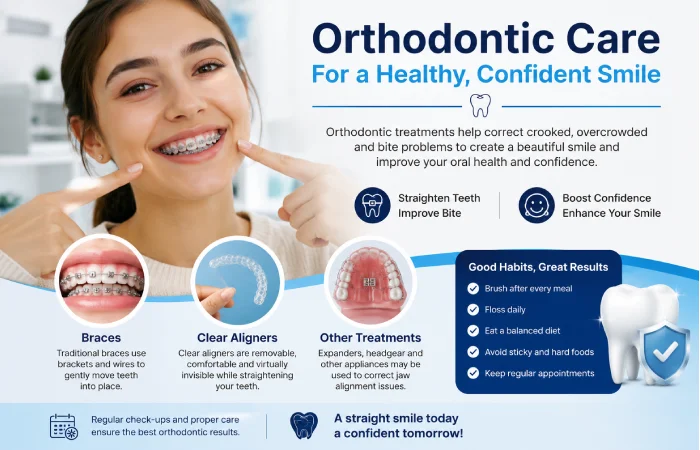
What is the most common orthodontic treatment? Braces and clear aligners are two most frequently occurring orthodontic treatments for crooked teeth. The dentist uses metal brackets and wires to move teeth into place.
Clear aligners are a more discreet alternative to braces, using custom-made, clear
trays to gradually move teeth. Both options can effectively straighten teeth,
but your orthodontist will recommend the best option based on your needs.
Traditional braces have several components
that work together to move teeth gradually. Brackets are attached to the
teeth, while an archwire applies controlled pressure. The orthodontic team
adjusts the appliance as treatment progresses so that the teeth can continue
moving toward their planned positions. Modern braces can also be designed with
smaller or less noticeable components, depending on the treatment plan and
available options.
Clear aligners work differently because they use
a series of removable trays rather than brackets and wires. Each aligner is
designed to fit the teeth in a particular stage of treatment, and the series
gradually guides the teeth toward their planned positions. Because aligners
can be removed, patients can generally brush and floss without having to work
around fixed brackets. However, they need to be worn as directed for the
treatment to work effectively.
Treatment Options
The two treatment options have different practical consideration. With braces they are attached to the teeth for the entire process, making remembering to place them in again after meals and hygiene a non-issue. With clear aligners, the patient is allowed to take them out to eat and practice hygiene; but the effectiveness of clear aligners rely on them being worn diligently each day as indicated by the orthodontist. Braces and clear aligners are not an appropriate treatment for every orthodontic issue; hence evaluation by an orthodontist still has importance.
Braces and clear aligners can do more than give you a more attractive smile, they can straighten your teeth and leave you with a smile you’ll love to show off. Just not if your teeth have dental crowns on them. Orthodontic force applied by either braces or aligners has the potential to dis Lodge the crown and may damage it beyond all repair.
There are sometimes cases where the orthodontist can accommodate your crowns, either by fitting their treatment around the crown, or by suggest options like bonding, or veneers. Make sure to notify your orthodontist immediately of any crowns you have before beginning any orthodontics treatment.
Dental Work
It is also crucial for people receiving orthodontic care to inform the orthodontist about any of the following: fillings in their teeth bridgesimplants past dental surgeries or treatments that they may have undergone missing teeth Dental work present does not automatically rule out receiving orthodontic treatment but can impact the treatment’s approach. Good oral health, free of decay and gum disease, is a key prerequisite for orthodontic care as is maintaining proper oral health while undergoing such treatment. Any such oral health problems may require prior treatment or management.
It is quite common for people to feel the tooth pressure or a certain level of discomfort after having an appliance placed or during an adjustment appointment.
Your orthodontist is the most reliable person to instruct patients on effective ways for managing pain or discomfort. Following a patient has new braces or aligners fitted, their teeth may take some time to get used to new oral apparatus. Having excellent hygiene practice may prove the easiest time adjusting possible if following doctor’s advice.
Preparing for Orthodontic Treatment
Before start treatment, patients can make
the process easier by understanding what will be expected of them. An
orthodontic consultation is an opportunity to ask questions about the proposed
appliance, expected treatment stages, appointments, cleaning requirements, and
any restrictions that may apply. Understanding the idea can make it easier to
follow instructions once treatment begins.
Patients should also consider their daily
routine. Someone who frequently travels, participates in sports, plays a
musical instrument, or has a busy school or work schedule may have particular
questions about managing orthodontic appliances. These lifestyle factors can
be discussed during the consultation so that practical concerns are considered
alongside the clinical requirements of treatment.
Another important part of preparation is establishing a diligent brushing and flossing routine prior to the appliance being placed. Food particles and bacteria will be able to accumulate in many new places around the brackets and wires of braces. Starting out with a diligent cleaning routine will make braces that much easier to cope with.
Maintaining Oral Health with Orthodontic Treatments

During The course Of Othrdontc Trtment The most Important thing The patient Must Remember Is how To take Care of the oral Hygiene so as To get The Best of orthodontic treatment. OralHygiene, diet Management and frequent check–up With theorthontist will have to b maintained so as To maintaingood Gum health and dental structure throughoutthe entire process of theTreatment of orthoodontics.
Your oral health should also be maintained during the period you have had orthodontic work done on. Brushing with toothpaste twice or three times a day would be of service in keeping you tooth healthy, so would flossing your teeth at the same time each day. Remember to eat properly too by not having too much of very acidic or sugary foods/drinks.
If you have had partial dental plates made then you will want to remember to take it out each time prior to washing your teeth.
Your removable teeth also want to be soaked from time to time using a cleansing tablet/solution to help wash away bacteria build up. It is good to keep up good hygiene, keeping also the use of their part denture health well.
Cleaning
Cleaning around orthodontic appliances
needs persistence and care. With braces, brushing should cover the
front, back, and chewing surfaces of the teeth as well as the areas around the
brackets and along the gumline. Flossing can require additional care because
the wire can make it harder to guide floss between the teeth. Special
orthodontic cleaning tools may be recommended by a dental professional when
appropriate.
People wearing clear aligners should also pay
attention to cleanliness. The trays should be handled according to the
instructions provided by the orthodontic team, and teeth should be cleaned
before placing the aligners back in whenever possible. Food and sugary drinks
left against the teeth while wearing aligners can create an environment that
may increase the risk of dental problems. Water is generally the simplest
choice while aligners are being worn, unless the orthodontist provides
different instructions.
Diet
Diet is another important part of maintaining
oral health with fixed braces. Hard, sticky, and chewy foods can place
unnecessary stress on brackets and wires or become difficult to remove from
around the appliance. Cutting suitable foods into smaller pieces and choosing
softer alternatives when necessary can help reduce problems. Patients should
follow the specific dietary guidance given by their orthodontist because
approvals can vary dependent on the appliance being used.
Regular dental appointments remain vital during
orthodontic treatment. An orthodontist focuses on tooth and jaw alignment, but
general dental care continues to play an important role in maintaining the
health of the teeth and gums. Professional cleaning and routine examinations
can help identify concerns that may otherwise interfere with successful
orthodontic treatment.
Managing Orthodontic Appliances
Taking care of an orthodontic appliance is an
important part of treatment. Fixed appliances should not be manipulated or
adjusted by the patient, and damaged wires or loose brackets should be reported
to the orthodontic team. Attempting to repair an appliance at home can create
additional problems or interfere with the planned movement of the teeth.
Removable appliances and clear aligners should
be kept in a safe, clean place when they are not being worn. Patients should
follow the cleaning and storage instructions provided for their particular
appliance. Keeping removable appliances away from hot surfaces and situations
where they can easily be lost can help protect them between uses.
Sports and other physical activities may also
require additional planning. Patients with braces may be advised to use
appropriate protective equipment during activities where the mouth could be
injured. Anyone who experiences significant damage to an orthodontic appliance
should contact the dental professional responsible for their treatment for
advice.
Other Orthodontic Treatments
In addition to braces and clear aligners,
other orthodontic treatments are available to correct jaw alignment
issues. Headgear and expanders are two standard options that can help align the
jaw and improve breathing. Your orthodontist will recommend the best option for
you based on your condition’s severity and your treatment goals.
Orthodontic treatments can improve a person’s
smile! A dentist will examine a patient’s mouth and teeth to determine the
patient’s needs.
Then they will plan a course of treatment to correct any
problems that need attention. Sometimes, a patient may need to wear braces or
have dental surgery. Some people who have had orthodontic treatment find that
their face looks and feels better when they smile again!
Care
Orthodontic care can sometimes involve more
than simply moving individual teeth. In certain cases, the relationship between
the upper and lower jaws needs to be considered when creating a treatment
plan. Appliances designed to influence dental or jaw development may be used
when appropriate, particularly while the jaws are still developing. The
specific appliance and timing depend on the individual’s dental and skeletal
needs.
In more complex cases, orthodontic treatment may
be coordinated with other areas of dental care. This can include restorative
dentistry or oral and maxillofacial care when necessary. Such treatment
planning is intended to address the overall condition of the mouth rather than
focusing only on the visible position of the front teeth.
What to Expect During Treatment
Typically, orthodontic treatment is not a one-time process. Following an initial exam, your orthodontist will formulate a course of action and plan how the teeth should be moved, and what will need to be done with your bite. You’ll return to your dentist at subsequent follow-up appointments to check progress and any necessary alterations to your appliance.
Patients may notice gradual changes in the
position of their teeth as treatment progresses. The pace of these changes
varies from one person to another, and teeth should not be expected to move
overnight.
The orthodontist can explain what progress is expected at each
stage and whether any modifications to the treatment plan are necessary.
Keeping scheduled appointments is important
because orthodontic treatment involves controlled, gradual movement. Missed
appointments can make it more difficult for the orthodontist to monitor the
appliance and maintain the planned treatment schedule. Patients should contact
their orthodontic office if they cannot attend an appointment so that another
appointment can be arranged.
After Orthodontic Treatment
Completing the active phase of orthodontic
treatment is not necessarily the end of the process. Teeth can naturally shift
over time, which is why orthodontists commonly use retainers after braces or
aligner treatment. Retainers help maintain the position achieved during active
treatment.
There are different types of retainers, and the
orthodontist will recommend the option that is appropriate for the patient.
Some retainers are removable, while others may be fixed in place. Following
instructions about how and when to wear a removable retainer is important for
maintaining the treatment result.
Retainers also require care. Removable retainers
should be cleaned as instructed and stored safely when they are not being worn.
Patients should report a broken, damaged. Or poorly fitting retainer to their
orthodontist rather than continuing to use it without professional advice.
Regular dental care should also continue after orthodontic treatment has
finished.
Other Cosmetic Dentistry Options
Dental crowns and other cosmetic dentistry alternatives You have alternatives other than orthodontia when it comes to enhancing your smile. As mentioned earlier, dental crowns, veneers and partial dentures are the other cosmetic dentistry. Choices that your dental professional can refer to as possible procedures for your teeth.
Cosmetic dentistry is the branch of dentistry
that deals with the art and science of improving the appearance and
functionality of your smile.
Many people choose to invest in cosmetic dentistry
treatments such as teeth whitening, dentures, dental implants, and
tooth-colored fillings. Because they enhance their smile’s appearance as well as
improve their overall comfort while they chew with confidence.
It is useful to understand the difference
between orthodontic and cosmetic dental care when considering treatment.
Orthodontics primarily addresses the position and relationship of teeth and
jaws. While cosmetic procedures generally focus on the appearance of the
teeth.
Cases
In some cases, a patient may benefit from one type of treatment. While
in other situations several forms of dental care may be considered together.
The order of treatments can also matter. For
example, a person considering cosmetic dental work may first need an
orthodontic assessment. If the position of the teeth affects the proposed
restorative treatment.
A dental professional can explain which concerns should
be addressed first and whether combining treatments is appropriate.
Patients must have reasonable expectations of what cosmetic and restorative dentistry can achieve. Since the ideal approach always varies depending on the status of their teeth, gums, bite, and any existing dental work, plus their overall objectives.
Orthodontic intervention should only be considered if an issue might actually be improved through the gradual shifting and positioning of the teeth. An assessment can define the difference between one issue amenable to some other kind of restoration and cosmetic fix. Versus those for which braces might, in some situations, be an option.
Choosing the Right Orthodontic Approach
There is no only orthodontic treatment that
is ideal for every patient. The right approach depends on the alignment of the
teeth, the bite. The condition of the gums and teeth, existing dental work,
age, lifestyle, and the desired outcome. A detailed professional assessment is
therefore more useful than choosing an appliance based only on appearance.
Patients may also want to consider how an
appliance fits into their everyday life. Fixed braces require careful cleaning
around brackets and wires, while removable aligners require consistent use and
safe storage. Understanding these responsibilities before treatment begins
can help patients choose an approach they are prepared to maintain.
There are other factors, such as cost, availability of appointment times. Time of the procedure and aesthetic and comfort issues that may have a bearing on your choice. These should be discussed openly with your orthodontist so that the treatment plan works. In practice and is best for your needs and your lifestyle.
Conclusion
If you’ve ever had a smile that you wanted to straighten. If you’d simply just like to gain confidence in the way you look. You are able to accomplish this with orthodontic treatments of all kinds! Orthodontics ranges from braces that will align crooked teeth to clear aligners that will do the same! Whether or not you need braces, consult with your personal orthodontist to check out all your orthodontics solutions.
Keep your mouth clean and healthy by taking proper care of orthodontics.
In doing so, you’ll give your treatment the boost needed for the smile you and even those around you have been searching for.
Orthodontic Treatment Resource Hub
Explore practical guides covering orthodontic treatments,
dental care, septoplasty recovery, oral health, healthcare,
back pain management and mental health treatments.
“`